EIFS Insulation Mortar Exporter: The Core Material Behind Energy-Efficient Façade Systems
Every energy-efficient wall begins with a reliable bonding layer.
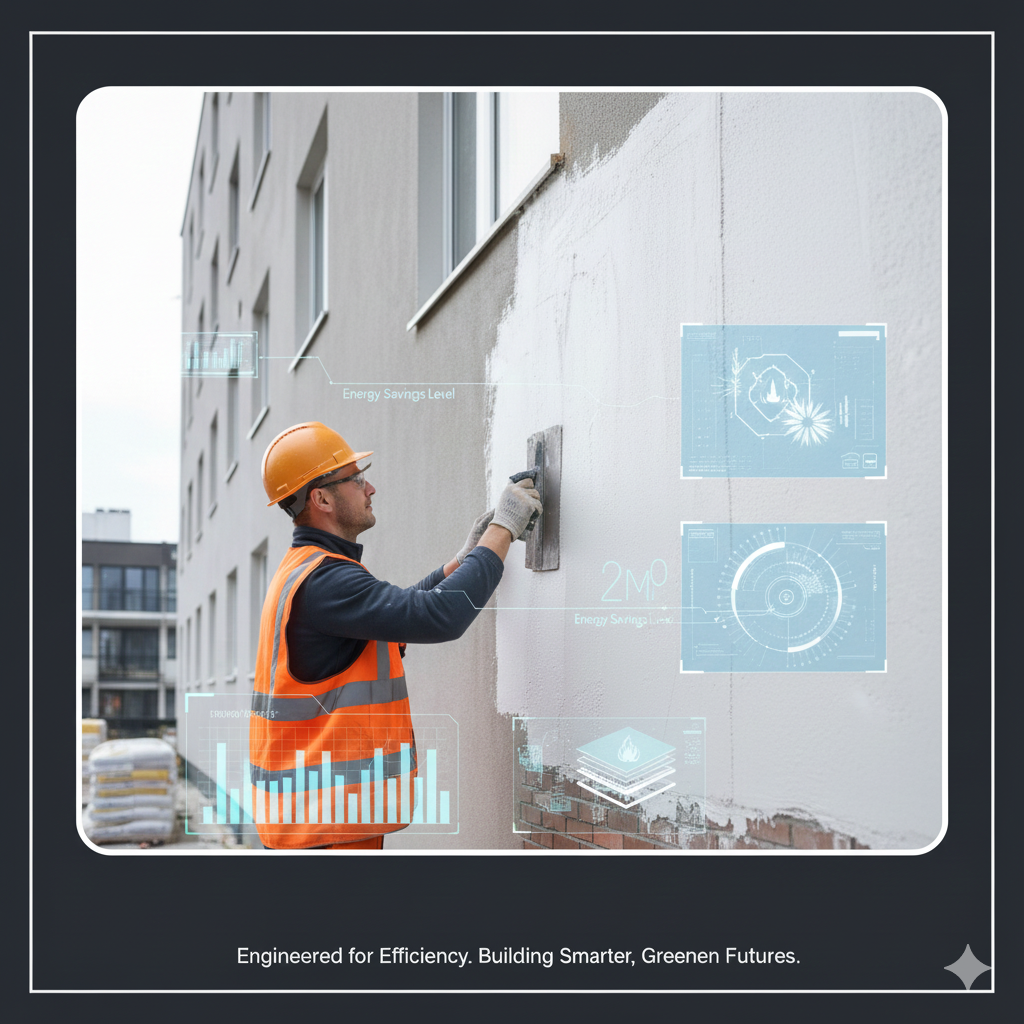
In modern façade systems, where thermal regulation and aesthetics must coexist, EIFS insulation mortar provides the critical link between the substrate, insulation board, and finishing coat.
A small failure in bonding or flexibility can lead to water ingress, heat loss, or complete system delamination.
1 | The Challenge: When Façade Systems Fail Before Their Time
Exterior insulation systems often fail not because of insulation panels—but because of mortar instability.
Common global project issues include:
-
Cracks from temperature cycles and wind stress.
-
Weak adhesion between insulation boards and substrate.
-
Water infiltration, leading to mold or frost damage.
-
Uneven curing, causing delamination or hollow sounds.
Each of these symptoms can compromise building performance and cause 10× higher maintenance costs over its lifecycle.
The key to long-term stability is a mortar that bonds, insulates, and resists environmental stress simultaneously.
2 | What Defines a High-Performance EIFS Mortar
YUNYAN’s EIFS insulation mortar integrates cementitious strength, polymer elasticity, and thermal insulation fillers, ensuring mechanical stability and flexibility across climates.
| Component | Function | Technical Benefit |
|---|---|---|
| Portland Cement Base | Structural binder | Core compressive strength ≥ 6 MPa |
| Redispersible Polymer Powder (RDP) | Flexibility & bonding | Enhances adhesion and crack resistance |
| Expanded Perlite / EPS Beads | Thermal insulation | Lowers λ-value ≤ 0.08 W/m·K |
| Glass Fiber Reinforcement | Micro-stability | Distributes mechanical stress |
| Hydrophobic Additives | Moisture control | Improves freeze–thaw resistance |
The result: a mortar that withstands both heat and frost, while maintaining adhesion on concrete, AAC blocks, or brickwork—essential for large façades under varying climate conditions.
3 | Comparison: Generic vs. EIFS-Grade Mortar
| Feature | Generic Mortar | YUNYAN EIFS Mortar |
|---|---|---|
| Adhesion Strength | 0.1 – 0.2 MPa | ≥ 0.4 MPa |
| Thermal Conductivity | 0.25 – 0.30 W/m·K | ≤ 0.08 W/m·K |
| Flexibility | Brittle | Polymer-elastic |
| Water Absorption | High | < 6% |
| Freeze–Thaw Resistance | 25 cycles | > 100 cycles |
In short, YUNYAN’s EIFS mortar is not just a glue—it’s the engineering foundation of energy-efficient façades.
4 | Inside YUNYAN’s Export-Grade Manufacturing System
YUNYAN’s production integrates precision batching, international certification, and OEM flexibility to serve global façade contractors and system integrators.
Manufacturing Workflow:
1️⃣ Automated Ingredient Weighing — ±0.3 % tolerance ensures formula accuracy.
2️⃣ Thermal Conductivity Testing — ASTM C518 verification per batch.
3️⃣ Flexural & Adhesion Strength Test — EN 13494 compliance for insulation mortars.
4️⃣ Moisture-Proof Packaging — Multi-layer 25 kg export bags.
5️⃣ OEM Customization — Localized branding, language labeling, and palletized container loading.
Each formulation is adjusted for regional humidity, temperature, and substrate materials, ensuring consistent curing and adhesion worldwide.
5 | Field Applications: From Energy Codes to Execution
| Application Zone | Primary Challenge | Recommended Solution |
|---|---|---|
| Residential Projects | Energy saving & façade cracking | Lightweight polymer EIFS mortar |
| Commercial Buildings | Wind load & large surface stress | Fiber-reinforced high-adhesion mortar |
| Cold-Region Construction | Freeze–thaw durability | Hydrophobic flexible formula |
| Coastal Buildings | Salt corrosion & humidity | Anti-alkaline modified system |
| Renovation / Retrofit Projects | Uneven base substrates | Fast-bonding repair mortar |
These flexible systems simplify installation and provide a uniform thermal envelope compatible with paints, tiles, or textured finishes.
6 | Installation Workflow and Key Controls
| Step | Process | Control Standard |
|---|---|---|
| 1. Substrate Prep | Clean, dry, and stable base | Moisture ≤ 5 % |
| 2. Mixing | 25 – 28 % clean water | Mechanical mix for 3 min |
| 3. Application | Notched trowel spread (3–5 mm) | Continuous layer, no voids |
| 4. Insulation Board Placement | Press and align | Max joint gap ≤ 2 mm |
| 5. Reinforcement Layer | Add mesh + basecoat | Uniform thickness 2 – 3 mm |
| 6. Finishing Coat | Texture, paint, or stone finish | Apply after 24 h curing |
Proper curing and weather control during application ensure adhesion consistency and long-term performance of the EIFS façade.
7 | Why Contractors and Export Partners Choose YUNYAN
-
Comprehensive EIFS System Support — Adhesive, basecoat, finish coat, and mesh in one solution.
-
Certified Performance — Tested under EN 998-1, ASTM C1583, and ISO 14001.
-
OEM & Private Label Export — Multi-region packaging and branding.
-
Sustainability Commitment — VOC-free, recyclable fillers, and low energy curing.
-
Global Logistics Ready — Flexible MOQs and containerized export handling.
YUNYAN acts as both manufacturer and technical partner, supporting clients with datasheets, on-site trials, and R&D customization.
Building Façades That Breathe, Insulate, and Endure
In an era where buildings must meet energy codes and climate durability, EIFS insulation mortar stands as the system’s unsung hero—lightweight, flexible, and resilient.
YUNYAN provides exporters, contractors, and developers with reliable façade bonding solutions built for performance and longevity.
For OEM cooperation, export partnership, or custom formulations, visit YUNYAN’s official website or reach our engineering team via contact page to explore global EIFS solutions tailored for your market.